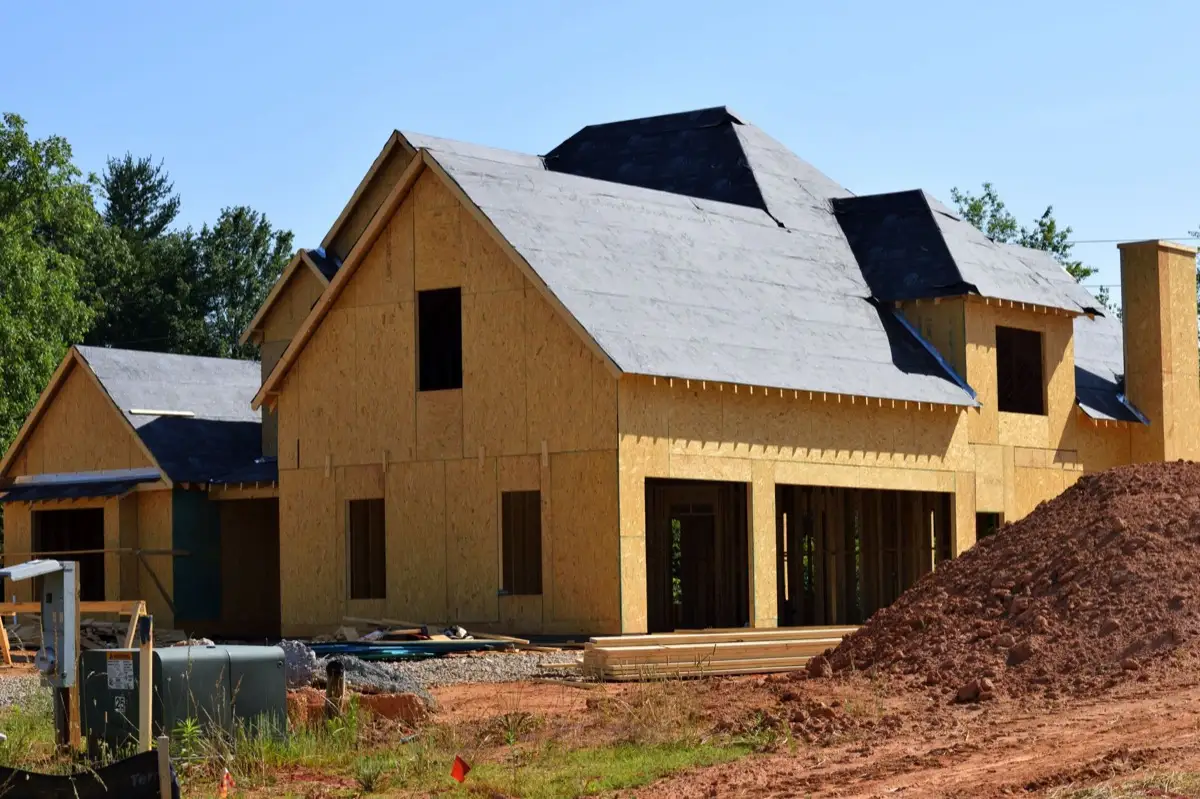
Underlayment is the only part of a roof you pay for and then never see again. The window in which anyone can verify what you actually got is the half day between tear-off and the first course of shingles.
Which makes it fertile ground for vagueness. "Synthetic" sounds like an upgrade and is not a specification. "30 lb felt" sounds like a weight, and ASTM stopped implying it was one by about 1982.
What underlayment for a roof is
Three jobs, in order of how often each earns its keep:
- Backup drainage plane. Water that works under a lifted tab, a slipped tile or a failed pipe boot runs down to the eave instead of into the sheathing.
- The temporary roof. Between tear-off and the last ridge cap the underlayment is the roof, through whatever weather turns up.
- Separation. It keeps the covering off the deck — resin bleed, condensation, tile rocking on plywood.
Is roof underlayment waterproof?
No, with one narrow exception, and the trade uses three different words for the gradient.
NRCA's Joan Crowe, in Professional Roofing in May 2005, sets the frame: steep-slope roof systems are water-shedding. Built from separate pieces laid shingle fashion, they pass water course to course by gravity, and the sheet underneath does the same on lapped seams — a secondary weatherproofing barrier, in her words, for what gets past the covering. Pond water on it, or turn that geometry sideways, and every lap is just a joint. Synthetics she rates a notch up, as water-resistant.
Which is not nothing: D8257 puts a hydrostatic test on synthetics and D4869's shower test measures liquid water moving through felt. But both test an intact sheet, and a roof is a sheet with several thousand fasteners driven through it.
Hence the narrow exception. ASTM D1970 is the only one of these standards that asks the sheet to stay sealed around a nail: Section 7.9 drives a roofing nail through a specimen adhered to plywood, backs it out a quarter inch, and stands a 5-inch head of water on it for three days. Which is why D1970 gets specified at eaves, valleys and penetrations — where water backs up rather than runs off, an ice dam being the obvious case.
NRCA's own asterisk on that: Mark Graham argued in November 2006 that backing the nail out "gaskets" the seal against the shank, making the test less demanding than the roof.
And the word "waterproofing" appears in the title of exactly one of these standards — ASTM D226, Asphalt-Saturated Organic Felt Used in Roofing and Waterproofing — which is the least waterproof product in the chapter.
Felt: ASTM D226, and what No. 15 and No. 30 mean
Asphalt-saturated organic felt is the original and still the cheapest. ASTM D226 covers two types: Type I, commonly called No. 15 asphalt felt, and Type II, commonly called No. 30.
The standard says "commonly called" because the felts have not weighed 15 and 30 pounds per 100 square feet for decades. Writing in IIBEC Interface in November 2019, Jeffrey Levine gives D226 Type I at roughly 11.5 to 13 lb per 100 sq ft and Type II at about 26. The names are a fossil nobody retired.
Worse, there is a second felt standard. ASTM D4869 was written for steep-slope roofing specifically, and unlike D226 it adds a liquid-water transmission pass/fail and dimensional-stability limits aimed at wrinkling. Sensible — except its lightest type runs around 8 lb per 100 sq ft, two-thirds of a D226 Type I, and both are sold at the yard as "15 lb felt." The label carries the answer. Nothing else does.
Felt's failure mode is not mysterious: it absorbs water, wrinkles as it dries, and telegraphs those wrinkles through the shingles. Over years it loses its volatiles and goes brittle, which is why a tear-off crew takes thirty-year-old felt off in confetti.
Synthetic is a category, not a standard
Synthetic underlayment is a woven or spun polypropylene or polyethylene scrim with a coating. That is the whole of what the word guarantees.
For roughly two decades there was no U.S. product standard at all. Products got into the code through an ICC-ES evaluation report written against AC188, the acceptance criteria for roof underlayments — and acceptance criteria are not consensus standards. The test requirements are settled between the manufacturer and the evaluation service, and AC188 cannot be cited in the I-Codes as a reference standard; it is an alternative compliance path for products the prescriptive code does not describe.
That changed in December 2020, when ASTM published D8257, Standard Specification for Mechanically Attached Polymeric Roof Underlayment Used in Steep Slope Roofing, after eight years of development. It tests tensile and tear strength, fastener pull-through and hydrostatic resistance after thermal cycling and accelerated weathering — deliberately, because the exposed period is when synthetics fail. NRCA's Mark Graham, in Professional Roofing in July 2021, expected it would miss the 2024 I-Codes. It did not: D8257 is in the 2024 IRC's list.
So a standard exists. A product can still be legal without meeting it, and the marketing does not distinguish.
Roof felt vs synthetic underlayment
| Felt (D226 / D4869) | Synthetic (D8257 or an ESR) | |
|---|---|---|
| Standard | Two, both product-specific | One, since 2020 — and optional |
| Weight per roll | Heavy; a square is a lift | A fraction of felt, for more coverage |
| Tear strength | Tears at the fastener in wind | Several times felt, on decent product |
| Water absorption | Absorbs, wrinkles, telegraphs | None |
| Walkability | Grippy, predictable | Grippy to genuinely dangerous |
| Vapor | Breathes as it ages | Usually under 1 perm, so a retarder |
Self-adhered modified bitumen: the one with real numbers on it
ASTM D1970 is the peel-and-stick membrane, and it is a real specification with its application written into its own title: …Used as Steep Roofing Underlayment for Ice Dam Protection. It bonds to the deck rather than sitting nailed over it.
The number that matters is thermal stability, and D1970's own baseline is exposure to about 176°F. Fine under asphalt shingles on a ventilated deck. Not fine under tile or metal, where the cavity and the panel underside run far hotter — Polyguard puts the environment a metal roof's underlayment must survive at roughly 240–265°F, and high-temperature grades are formulated for that band rather than the standard's floor. Specifying general-purpose D1970 under standing seam is the commonest expensive mistake in the subject.
The trade-off is permeability: fully adhered over the whole deck puts a vapor barrier on the outside of the assembly, the wrong side in most climates, so full-coverage peel-and-stick belongs on the roofs that need it and not everywhere by default. How long it lasts under tile, and why that clock schedules your spending, is in how long does a tile roof last.
Problems with synthetic roof underlayment
Slip. Many are slick wet or frosted. Coarse-surfaced versions exist precisely because the smooth ones put crews on the ground.
Ultraviolet exposure. The 90 to 180 day rating is a warranty term rather than a performance promise, and the sun does not read warranties.
Vapor. A sub-1 perm sheet slows drying on the underside of a cold deck, exactly where nobody can see it. Graham's point too: some are vapor-open, some are not, and the packaging rarely leads with it.
Fastening. A staple through a synthetic is a hole with nothing holding the sheet. Cap nails are what the product is designed around.
Laps, caps and the order it goes down
Underlayment fails at its edges, so the geometry is code, not preference. Table R905.1.1(2), asphalt shingles:
- 4:12 and steeper: one layer, shingle fashion from the eave, lapped 2 inches, end laps 4 inches, end laps offset 6 feet course to course.
- 2:12 to under 4:12: two layers — a starter half a sheet wide at the eave, then full 36-inch sheets each overlapping the sheet below by half a sheet plus 2 inches.
- In wind design areas, mechanically fastened underlayment takes corrosion-resistant annular ring or deformed shank nails with 1-inch-diameter metal or plastic caps in a 12-inch grid between side laps, 6 inches at side and end laps, penetrating not less than 3/4 inch into the sheathing.
Two field notes. The six-foot offset exists so end laps never stack into a channel, and skipping it is invisible from the ground forever. And underlayment goes over the drip edge at the eave and under it at the rakes — a reversal worked through in what is a drip edge.
What is code and what is the manufacturer's
Both are enforceable, by different routes.
Code. IRC R905.2.2 is the slope rule behind those two cases: asphalt shingles at 2:12 minimum, double underlayment below 4:12. R905.1.1 is the general underlayment section: it lists the acceptable standards — ASTM D226, D1970, D2626, D4869, D6380 Class M, D6757 and D8257 — and requires materials to bear a label indicating compliance. That label is your only practical verification tool. Eave ice barriers sit in a separate provision, R905.1.2, and are not a national requirement. Section numbers read on UpCodes against the 2024 residential code, since ICC's own site refuses automated access; the numbering is stable back through the 2018 edition.
Manufacturer's. IRC R904.1 requires roof coverings to be applied per the chapter and the manufacturer's installation instructions — which is how a shingle maker's demand for a particular underlayment, or a stated exposure limit, becomes something an inspector can enforce. Firestone, Colorado's re-roof handout says exactly that, and requires a mid-roof inspection with every elevation dried in and no more than a quarter of the covering on. Whether your jurisdiction runs one is worth asking before the job starts.
Who is permitted to do the work in Texas
Relevant here because the underlayment is the one part no homeowner can audit afterwards, so the permit and the credential are most of what you have — whatever roofing credential your state issues, which in several states is none at all.
Texas issues no roofing license of any kind, so a state number is not something any roofer here can show you. A contractor also may not act as a public adjuster on a property it may work on, even holding an adjuster license.
Bottom line
Ask for the product name and the standard it meets, not the category, and under tile or metal ask about the temperature rating specifically. Then photograph the roll label and the dried-in deck, because that is the last day the evidence exists.
Abilene Premium Roofing does written roof inspections, roof leak repair and full roof replacement across Abilene and west central Texas, and we put the underlayment product on paper before we order it. Call (877) 881-2921.
Ready for a free quote in Abilene?
Abilene Premium Roofing — free estimate, clear scope, no pressure. Use the form on this page or jump to the homepage quote.
Related services in Abilene
Abilene Premium Roofing money pages — go straight to the service you need.
- Roof Replacement →
A replacement is the one moment you get to decide what your Abilene roof does with the water that lands on it. We ask that before we ask about color, because in a town living under permanent watering limits the answer changes the deck, the metal and the gutter.
- Roof Leak Repair →
Twenty-five inches of rain a year is not much, and that is exactly why an Abilene leak is dangerous. A roof here can be badly compromised and stay dry for months, so the stain on your ceiling is rarely the first sign.
- Roof Inspections →
Most roof inspections in this market are a sales call with a ladder. Ours produces a document: condition and remaining years stated per slope, dated photographs, and a plain sentence about whether anything needs doing this year.
- Storm Damage Restoration →
Storms arrive here in a handful of violent afternoons between April and June, and the cells that break roofs are the only cells that fill anything. That shapes how we work a loss in Abilene.
- Hail Damage Roofing →
Hail damage to a shingle is not a dent you can see. It is a fractured fiberglass mat under a bruise, with the granule layer knocked loose so ultraviolet light gets at the asphalt.
Frequently asked questions
What is underlayment for a roof?
It is the sheet that goes on the bare deck before the covering, and it is a secondary water barrier rather than the roof. Shingles, tile and metal shed water off the surface; the underlayment catches what gets past them, carries it down to the eave, and keeps the deck dry during the days or weeks it is uncovered mid-job.
Three families are in normal use: asphalt-saturated felt, synthetic polymer sheet, and self-adhered modified bitumen. Only two of the three are covered by a product standard written specifically for them.
Is roof underlayment waterproof?
Almost none of it is, and that is the design rather than a shortcoming. NRCA classes steep-slope roofs as water-shedding assemblies — pieces laid in shingle fashion, gravity carrying water from one course to the next — and the underlayment does the same job on lapped seams as a secondary barrier.
Felt sheds; synthetics are rated water-resistant; neither is built to sit under a standing head of water. The exception is self-adhered polymer-modified bitumen to ASTM D1970, whose physical requirements include staying sealed around a nail driven through it. That is why it turns up at eaves, valleys and penetrations rather than over a whole deck.
What do 15 lb and 30 lb felt actually mean?
Not weight, not since the early 1980s. ASTM D226 calls them Type I, commonly called No. 15 asphalt felt, and Type II, commonly called No. 30, because the felts stopped weighing 15 and 30 pounds per 100 square feet long before the names changed.
Writing in IIBEC Interface in November 2019, Jeffrey Levine put D226 Type I at roughly 11.5 to 13 pounds per 100 square feet and Type II at about 26. There is also a second felt standard, ASTM D4869, whose lightest type is around 8 pounds.
Both get sold as 15 lb felt and there is no way to tell them apart by eye.
Is felt or synthetic underlayment better?
That question does not have one answer, because synthetic is not one product. Felt is a defined material with a published mass and a known failure mode: it absorbs water, wrinkles, and gets brittle with age.
Synthetic covers everything from a heavy woven scrim to a thin sheet chosen on price, and until ASTM D8257 was published in December 2020 there was no U.S. product standard for any of it. A good synthetic beats felt on tear strength, weight and how long it can sit exposed. A cheap one only beats it on weight.
Ask which product, not which category.
What are the problems with synthetic roof underlayment?
Four worth knowing. Many are genuinely slippery when wet or frosted, which is a crew-safety issue and the reason coarse-surfaced versions exist. Ultraviolet exposure ratings run from around 90 to 180 days and vary by product, and that is a warranty term rather than a performance promise.
Most sit under 1 perm, so they behave as vapor retarders on the underside of a cold deck and can slow drying in an assembly that is not ventilated. And the category is so wide that two rolls with the same marketing language can be different products.
Does code require two layers of underlayment?
On low-slope asphalt shingle roofs, yes. IRC R905.2.2 permits asphalt shingles only at 2:12 or steeper, and from 2:12 up to 4:12 it requires double underlayment application per Section R905.1.1.
Table R905.1.1(2) spells that out as a starter strip half a sheet wide at the eave, then full 36-inch sheets each overlapping the one below by half a sheet plus 2 inches. At 4:12 and steeper a single layer lapped 2 inches is permitted. This is code, not a manufacturer preference, and your local amendments can be stricter.
How long can underlayment be left exposed before the roof goes on?
Whatever the product's own literature says, and that number is shorter than most people assume. Felt is not intended for meaningful exposure at all and begins to wrinkle with the first rain. Synthetics publish exposure ratings commonly in the 90 to 180 day range, and self-adhered membranes usually publish a shorter one.
Exceeding it does not necessarily cause a leak, but it does void the part of the warranty you might one day want, and it is one of the few underlayment facts you can verify after the fact from a dated photo.
Local context
How this applies in Abilene, TX
Every article here is written from roofing work done in Abilene and west central Texas, so the numbers reflect local labour, permit and material costs rather than a national average. Your own job can land either side of them depending on access, the condition of what is already there, and the materials you pick — Galvalume aluminum-zinc alloy coated steel panels, first-flush diverter standpipes with pinhole drains, thirty-micron roof washer cartridges.
The way to turn any of this into a real answer is to have someone look at your actual situation. The free estimate is free, itemized and written down, with no deposit and no obligation. Call (877) 881-2921 or start on the Abilene Premium Roofing homepage.
Areas Abilene Premium Roofing covers
Abilene first, then the surrounding communities of west central Texas. Each has its own page with local detail rather than a copy of this one:
- Tye, TX — Taylor County, population 1,176
- Merkel, TX — Taylor County, population 2,471
- Buffalo Gap, TX — Taylor County, population 543
- Tuscola, TX — Taylor County, population 850
- Lawn, TX — Taylor County, population 311
- Clyde, TX — Callahan County, population 3,811
Or jump to the full list of Abilene services.
More from the Abilene Premium Roofing blog
- Spanish Roof Tile in Abilene: A Shape, Not a Material
Spanish tile names a profile, and that profile comes in clay, concrete and molded polymer at wildly different weights. What that means for framing, freeze-thaw and re-roofing in Abilene, TX.
- Roof Ridge Vent Installation Cost in Abilene: Timing Sets It
A ridge vent is close to free during a re-roof and a real job as a retrofit in Abilene, TX. The drivers, the ratios, and the line item most quotes leave out.
- Roof Moss Treatment in Abilene: Why the Fast Method Ends the Roof
Moss on asphalt shingles has one correct treatment and one destructive one that sells better. What ARMA and the shingle warranties actually say, and what it costs in Abilene, TX.
The Abilene Premium Roofing Team
roofing specialists serving Abilene, TX
Written by the Abilene Premium Roofing team — insured roofing pros serving Abilene, TX and the surrounding area.