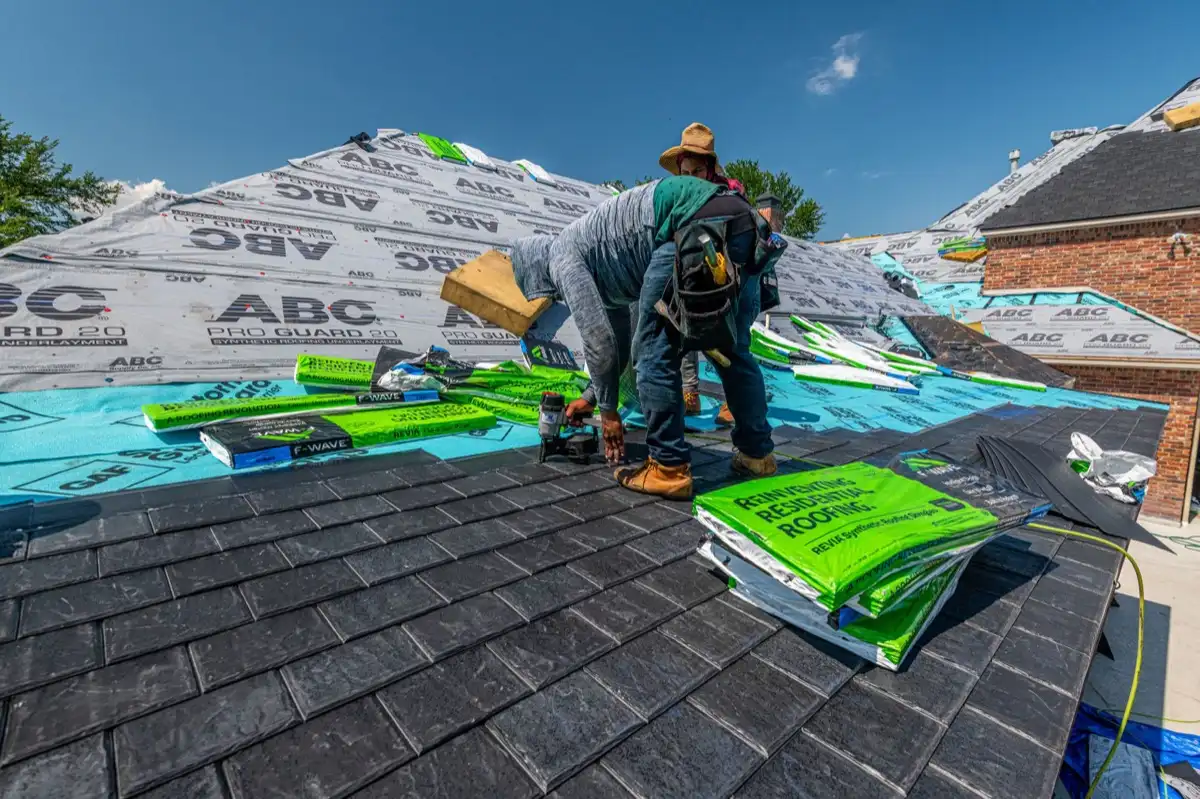
A tile roof has two lifespans, and almost every page answering this question gives you the flattering one. The tile is good for 50 years and often far longer. The underlayment beneath it, which is the layer actually keeping water out of your house, is good for 20 to 30 and less than that where it gets hot.
Those two numbers are decades apart, and the second one is the one that schedules your spending.
The tile is not the roof, so its lifespan is not the roof's
A tile roof sheds water off the surface and lets the rest run underneath, where a membrane on the deck carries it to the eave. The Tile Roofing Industry Alliance puts it plainly: most tile roofs are not completely waterproof, and the underlayment is the waterproofing layer. Why that assembly works, what the profiles are and what the whole thing weighs is in Spanish roof tile.
The consequence: the expensive, visible, durable component is not the one on the clock. Asphalt is genuinely different: covering and waterproofing are the same object and wear out together, which is why asphalt shingle lifespan is one number and tile is two. That number, and the service-life table for every common covering, is in how long does a roof last.
So "my roof is 45 years old" means nothing on tile until you know which layer is 45.
How long does a concrete tile roof last, and clay
| Layer | Commonly published | What decides it |
|---|---|---|
| Clay tile | 50–100+ yrs | Frost grade, breakage, not weathering |
| Concrete tile | 40–70 yrs | Absorption and surface finish, not the body |
| The underlayment under either | 20–30 yrs | Heat, and which product was used |
Sources disagree widely inside the tile rows. The Tile Roofing Industry Alliance publishes no number at all, saying only that manufacturer warranties exceed those of other roofing products, while contractor pages routinely quote 50 to 70 for concrete and 80 to 100 plus for clay. Treat the high end as evidence that old tile roofs exist, not as a forecast for yours.
The real clay-versus-concrete difference is not longevity but how each ages. Clay's color is fired into the body and does not fade. Concrete absorbs more water and often carries its color as a sprayed slurry, so at twenty years a concrete roof can look chalky while remaining structurally fine. Homeowners replace tile over that appearance fairly often. Fading is not failure, and a pressure washer aimed at it does more harm than the twenty years did.
The underlayment is the clock
Three products go under tile, and their service lives are nowhere near equal.
No. 30 asphalt-saturated felt, ASTM D226 Type II, is what sits under most tile roofs built before about 2000. Organic, and it dries out. The commonly published range is 20 to 30 years, and the failure mode is not a hole but embrittlement — felt that tears when you touch it.
Synthetic, a woven or spun polymer sheet. Tear strength far beyond felt and it does not absorb water, but the category is wide and thin products age quickly in a hot cavity. Specify a high-temperature grade.
Self-adhered modified bitumen, the peel-and-stick membrane made to ASTM D1970, is the current answer in hot and high-wind markets. It glues itself to the deck and closes back around every nail or screw driven through it, which matters because a tile roof is fastened through its own waterproofing several thousand times. Products intended for tile publish temperature resistance well above the 176°F that D1970 itself requires — Polyglass rates its Polystick MTS to 265°F. Trade sources put self-adhered at roughly 25 to 35 years under tile.
That ordering is not controversial. The sting is that the cheapest line item on a tile re-roof is the one deciding when you do the whole job again.
Warranty term and service life are different numbers
The metal and slate version of this argument is in how long does a metal roof last. On tile it takes a specific and slightly absurd shape.
Eagle Roofing Products issues a transferable limited lifetime product warranty on its concrete tile. Read what it covers: water passing through the body of the tile, from structural deterioration or a manufacturing defect, assessed against ASTM C1492 clause 7.4 (transverse strength) and 7.5 (permeability). It expressly excludes surface cracking, chipping, slurry coating delamination, efflorescence, color, and damage caused by roof traffic or other trades. Labor, freight, underlayment and nails are covered only during the first ten years, and only where a verified defect let water into the structure.
Then the sentence that settles the argument, in capitals at the top of the document: a complete lift and relay greater than three squares renders the limited lifetime warranty null and void.
So a lifetime warranty covers the component that was never going to fail, excludes the one that will, and is extinguished by the maintenance operation a tile roof is certain to need. Not a dishonest document — a materials warranty behaving like a materials warranty. It simply answers a different question from the one buyers think they are asking.
The underlayment side is starker. Polyglass warrants against manufacturing defects that directly result in leakage for one year, with a 30-year term available on a two-layer system. One year, on the layer that is the actual roof.
Ask for the underlayment's warranty document, not the tile's.
How long does a tile roof last in Arizona and other hot markets
Heat is the underlayment's enemy and the cavity under tile is where heat lives. Tile shades the deck, which is why it is a decent thermal choice, but the air space beneath runs hot for long stretches and the membrane cooks in it.
Phoenix-area contractors commonly report organic felt failing at roughly 18 to 22 years rather than the 20 to 30 quoted nationally, and put high-temperature synthetics and self-adhered membranes at 25 to 35 under the same tile. Those are trade figures from contractor publications, not laboratory data — bracketing rather than precision. The direction is consistent enough to plan around.
The practical version: in a hot market, budget the relay at year 20 and inspect from year 15. In a mild one you may genuinely get 30. The tile does not care either way.
What actually kills tile roofs early
Rarely the weather. In order of how often it shows up:
Foot traffic. Solar crews, satellite installers, painters and chimney sweeps. Eagle's own owner instructions say to step on the bottom three inches of an installed tile, where the tile beneath supports it, and warn that broken tile lets water and ultraviolet reach the underlayment. That is the mechanism — a cracked tile does not leak, it exposes the membrane to sunlight, and the membrane dies where the tile is broken.
Fastener corrosion. Nails and screws holding tile penetrate the underlayment and sit in an assembly that condenses. Wrong-metal or undersized fasteners rust, tiles loosen at the heads, and the relay finds them.
Batten rot. Where tile is set on wood battens, the battens dam water running down the underlayment unless they are counter-battened or notched to drain. Trapped water rots the batten, the deck under it, or both, and nothing is visible from the ground.
Flashing nobody replaced during the last relay. The expensive failure. A relay is a full re-roof with the covering reused, so valley metal, headwall and sidewall flashing, pipe boots and eave closures should come off with the tile. A crew pricing on speed puts new membrane down and old flashing back on top of it, and the roof leaks at the details on a fresh underlayment. Flashing detail, and why it fails, is in flashing on a roof.
How long does a cedar shake roof last
Wood belongs here because the answer has the same shape: the number is mostly about behavior, not material.
Roughly 30 to 40 years is the common figure, with 50-plus cited for maintained roofs. The Cedar Shake and Shingle Bureau attributes the spread to grade, climate, installation, maintenance, foot traffic and overhanging trees, and notes that pressure-impregnated preservative-treated products generally outlast untreated ones, especially in humidity. Shade and debris are the killers — a cedar roof under trees holds moisture and can be finished in half the time an exposed, cleaned one takes. Brush and an oxygen bleach solution, never a pressure washer.
Who is allowed to do a relay in Texas
Worth knowing, because a lift and relay gets sold as maintenance. It is not maintenance. The tile comes off, the waterproofing is replaced and the flashings should be — a re-roof by any working definition, permitted like one, and subject to whatever roofing credential your state requires, which in several states is none.
Texas issues no roofing license of any kind, so a state number is not something any roofer here can show you. A contractor also may not act as a public adjuster on a property it may work on, even holding an adjuster license.
When the age of a tile roof becomes an insurance argument in Texas
Two lifespans make a claim file messy. A carrier looking at 45-year-old tile applies a schedule built for a covering that wears out as a surface, while the layer that actually failed may be six years old, or fifty. Expect to have to prove which.
Whatever the fight, what you can do once a denial arrives in writing is set by state law rather than by your policy — including, in several states, nothing.
Texas gives you no right to cancel after a claim is denied, and that is worth saying plainly because so much roofing copy implies otherwise. What Texas does require is a specific notice in twelve-point boldface on any contract over a thousand dollars expected to be paid from insurance proceeds. Read that paragraph before you sign it.
Bottom line
Stop asking how long the tile lasts. It lasts longer than you will own the house. Ask when the underlayment went down, what product it was, and whether the flashings were replaced with it — three answers that fit on an index card and decide everything. Budget the relay somewhere in year 20 to 30, sooner in heat. Keep everyone off the tile. And read the underlayment warranty, because the tile warranty is a lifetime document about the part that was never at risk.
Abilene Premium Roofing does written roof inspections that include lifting tile to date the underlayment, plus tile repair and full roof replacement across Abilene and west central Texas. Call (877) 881-2921 and we will tell you which of your roof's two clocks is running out — including when the answer is neither.
Ready for a free quote in Abilene?
Abilene Premium Roofing — free estimate, clear scope, no pressure. Use the form on this page or jump to the homepage quote.
Related services in Abilene
Abilene Premium Roofing money pages — go straight to the service you need.
- Roof Replacement →
A replacement is the one moment you get to decide what your Abilene roof does with the water that lands on it. We ask that before we ask about color, because in a town living under permanent watering limits the answer changes the deck, the metal and the gutter.
- Roof Leak Repair →
Twenty-five inches of rain a year is not much, and that is exactly why an Abilene leak is dangerous. A roof here can be badly compromised and stay dry for months, so the stain on your ceiling is rarely the first sign.
- Roof Inspections →
Most roof inspections in this market are a sales call with a ladder. Ours produces a document: condition and remaining years stated per slope, dated photographs, and a plain sentence about whether anything needs doing this year.
- Storm Damage Restoration →
Storms arrive here in a handful of violent afternoons between April and June, and the cells that break roofs are the only cells that fill anything. That shapes how we work a loss in Abilene.
- Hail Damage Roofing →
Hail damage to a shingle is not a dent you can see. It is a fractured fiberglass mat under a bruise, with the granule layer knocked loose so ultraviolet light gets at the asphalt.
Frequently asked questions
How long does a tile roof last?
It has two lifespans and you need both. The tile is commonly given 50 years or more, clay longer than concrete, and plenty of clay roofs are past a century. The underlayment beneath it, which is the layer actually keeping water out of the house, is usually given 20 to 30 years and less than that in real heat.
So the tile is not what schedules your spending. The membrane is, and a page that answers this question with one flattering number has told you about the part that was never going to fail.
How long does a concrete tile roof last?
Published figures cluster around 50 years for concrete and run higher for clay, with contractor sources commonly quoting 50 to 70 for concrete and 80 to 100 plus for clay. The gap is real but smaller than it looks in practice, because on most roofs neither tile is the thing that gives out.
Concrete absorbs more water than fired clay and its color is a surface slurry on many products, so a concrete roof tends to look older than it is while remaining perfectly sound. Fading is not failure.
How long does a tile roof last in Arizona?
The tile does fine. Arizona is hard on the layer under it.
Air temperature is only part of the load, because the space beneath a tile is a hot, ventilated cavity in relentless ultraviolet, and organic felt in that environment is commonly reported failing at roughly 18 to 22 years by Phoenix-area contractors rather than at the 20 to 30 quoted nationally.
High-temperature synthetics and self-adhered modified bitumen are the usual answer and are commonly put in the 25 to 35 year range under tile. Those are trade figures, not laboratory ones.
How often does tile roof underlayment need to be replaced?
Once or twice in the life of the tile, which is why lift and relay exists as a job. The trade rule of thumb is to plan on it somewhere between year 20 and year 30 for a felt underlayment and to start inspecting rather than assuming from about year 15. Nobody replaces it on a calendar.
It is replaced when an inspector reports felt that tears at a touch, granule loss on the membrane surface, or staining on the deck, and the honest version of that inspection means lifting tile in several places rather than looking at the roof.
Does a lifetime warranty on tile mean a lifetime roof?
No, and one manufacturer's document makes the point better than any argument. Eagle Roofing Products issues a transferable limited lifetime warranty on its concrete tile, which covers water passing through the body of the tile due to structural deterioration or manufacturing defects, judged against the transverse strength and permeability clauses of ASTM C1492.
It excludes surface cracking, chipping, slurry coating delamination, efflorescence, color and damage from roof traffic, and it states that a complete lift and relay greater than three squares renders the lifetime warranty null and void. The one maintenance operation a tile roof is certain to need ends the warranty on the tile.
How long does a cedar shake roof last?
Roughly 30 to 40 years is the common figure, with 50 or more cited for well-maintained roofs, and the spread on wood is wider than on any other covering because so much of it is owner behavior.
The Cedar Shake and Shingle Bureau attributes the variation to grade, exposure, installation, maintenance, foot traffic and overhanging trees, and notes that pressure-impregnated preservative-treated products generally outlast untreated ones, particularly in humidity. A shaded, unwashed cedar roof under trees can be finished in half the time a maintained one takes.
Local context
How this applies in Abilene, TX
Every article here is written from roofing work done in Abilene and west central Texas, so the numbers reflect local labour, permit and material costs rather than a national average. Your own job can land either side of them depending on access, the condition of what is already there, and the materials you pick — Galvalume aluminum-zinc alloy coated steel panels, first-flush diverter standpipes with pinhole drains, thirty-micron roof washer cartridges.
The way to turn any of this into a real answer is to have someone look at your actual situation. The free estimate is free, itemized and written down, with no deposit and no obligation. Call (877) 881-2921 or start on the Abilene Premium Roofing homepage.
Areas Abilene Premium Roofing covers
Abilene first, then the surrounding communities of west central Texas. Each has its own page with local detail rather than a copy of this one:
- Tye, TX — Taylor County, population 1,176
- Merkel, TX — Taylor County, population 2,471
- Buffalo Gap, TX — Taylor County, population 543
- Tuscola, TX — Taylor County, population 850
- Lawn, TX — Taylor County, population 311
- Clyde, TX — Callahan County, population 3,811
Or jump to the full list of Abilene services.
More from the Abilene Premium Roofing blog
- How Long Does a Roof Last in Florida? The Law, Not the Shingle
Florida's sun shortens a roof and Florida's rules decide when it stops being insurable. What s.
- How Long Does a Metal Roof Last in Abilene? The Coating Decides
A metal roof's life is set by its coating and fasteners, not the metal. Plus real service life for slate, rubber, TPO and composite roofs in Abilene, TX.
- Hail Damage to a Roof and Insurance in Abilene: What the Policy Already Decided
Hail is the peril carriers rewrote the policy around. Cosmetic exclusions, roof settlement schedules and percentage wind-hail deductibles decide a Abilene, TX claim before anyone climbs the ladder.
The Abilene Premium Roofing Team
roofing specialists serving Abilene, TX
Written by the Abilene Premium Roofing team — insured roofing pros serving Abilene, TX and the surrounding area.