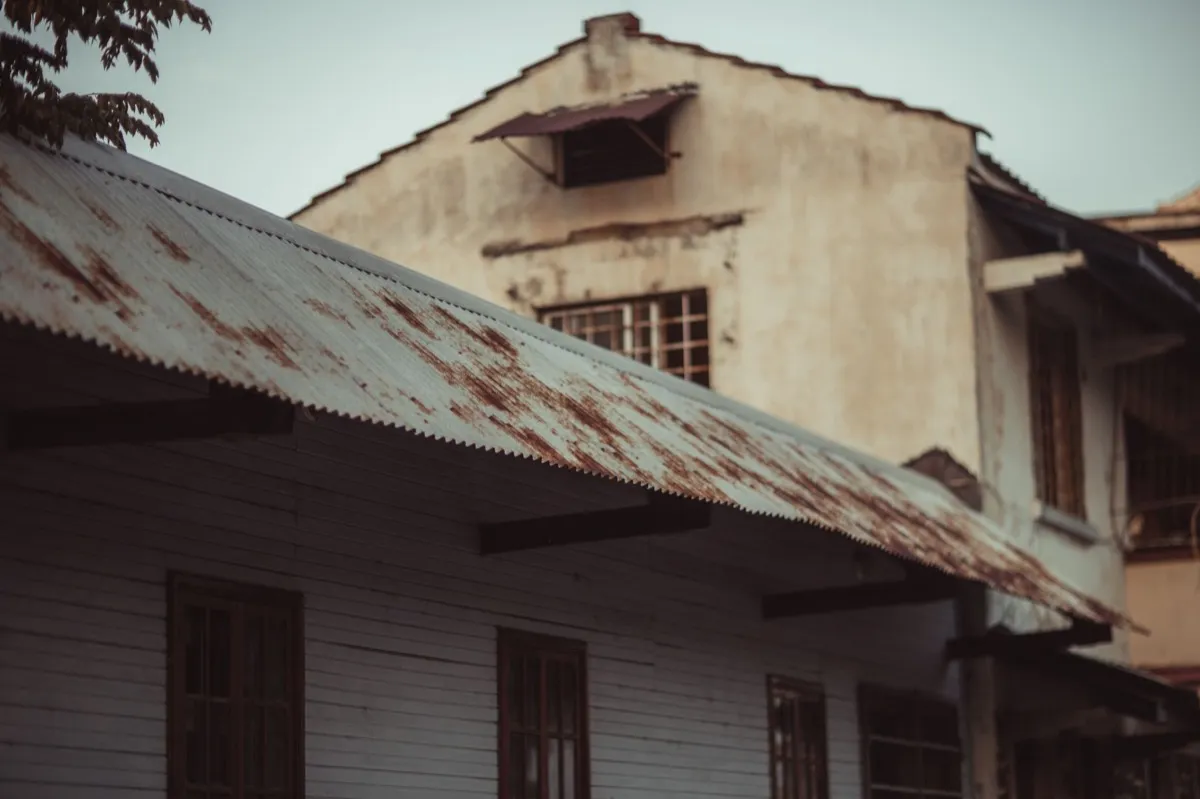
A standing seam roof and a screw-down ag panel are both metal, and they do not last the same length of time. Neither does slate at a century, EPDM at twenty-five years, or a molded composite tile nobody has yet owned for fifty. The useful number is never attached to the material but to whichever part of the assembly dies first.
Asphalt wears out as a surface, so you can look at it and know where you are. These systems fail at a component — a gasket, a nail, a seam, a termination — while the expensive part is still sound. Asphalt lifespan and the service-life table for every common covering live in how long does a roof last; this is the non-asphalt half.
A metal roof's first clock is the coating
Steel does not decide this. The coating over it does: it corrodes instead of the steel, and when it is gone the clock stops.
Galvanized is zinc, specified by coating weight under ASTM A653 — G90 is 0.90 ounces per square foot across both faces, G60 is 0.60. Galvalume is an aluminum-zinc alloy, roughly 55 percent aluminum, specified under ASTM A792 as AZ50 or AZ55, and manufacturer literature — a vendor figure, not an independent study — commonly puts it at two to four times the inland life of comparable galvanized. It also carries exclusions galvanized does not: keep it off wet concrete and mortar, off animal confinement buildings, and out from under anything that drains copper onto it.
Then the paint, a second clock over the first. SMP, silicone-modified polyester, is a hard, cheap film. PVDF, sold as Kynar 500 or Hylar 5000, is a fluoropolymer that holds color and resists chalking far longer. AAMA 2603, 2604 and 2605 separate them, and between the top two the difference is mostly duration: both demand a chalk rating of 8 or better and no more than 5 Delta E of color change, but 2604 proves it after five years on a south-facing Florida rack and 2605 after ten. A cheap panel is lighter gauge, lighter coating and SMP: a shorter clock, legible on a spec sheet.
Its second clock is the fastener
An exposed-fastener roof is a roof with several thousand screws through the face of the panel, each sealing on a bonded EPDM washer that is the weather barrier and the shortest-lived thing up there. Overdrive the screw and it squeezes out past the head where sunlight reaches it; underdrive it and it never seals. Thermal cycling walks them, because the panel moves and the fastener resists.
The consequence for lifespan: the panel is warranted, the gaskets are maintained, and the roof's real life is the shorter of those two clocks. What re-fastening costs, and why a metal leak is rarely one leak, is in cost to fix a leak in a roof; whether to buy the panel at all is in metal roof vs shingles.
Standing seam hides the fastener under concealed clips, which on longer runs must be the floating kind so the panel can expand without elongating its own holes. It fails at its details instead — seam sealant, penetration flashings, the chimney transition — which is what inspecting a metal roof actually means.
Warranty term and service life are different numbers
A warranty says what a manufacturer will pay for under conditions it wrote. Service life is what the assembly does on your building. Metal comes with two documents: a substrate warranty against perforation by corrosion — a hole, not an appearance — and a finish warranty, three promises with three tolerances covering film integrity, chalking on a published scale, and fade in color-difference units. Generous chalk and fade tolerances promise the panel will still be a panel, not that it will still be your color.
Most are prorated toward nothing, most exclude labor, many exclude coastal exposure, and nearly all carry transfer conditions that matter when you sell. Membranes add their own split: a material-only warranty covers the sheet, while an NDL — no dollar limit — warranty covers workmanship too, requires a manufacturer-approved installer, which is a private credential unrelated to any state one, and imposes inspection duties the owner must actually perform or void it.
How long does a slate roof last
Slate is graded rather than warranted. ASTM C406 sorts it into S1, S2 and S3 by absorption, weathering and strength, with expected service lives over 75 years, 40 to 75, and 20 to 40. The quarry predicts the grade better than anything visible from the ground.
Then the interesting part: the roof outlives its own hardware. Nails corrode — British roofers call it nail sickness, and it is what it sounds like, slates sliding off a roof whose stone is fine. Copper and lead valley and chimney flashings wear through on their own schedule, so a roof with a century in it needs them renewed once or twice. That is scaffolding and a slater, and it is the bill nobody budgets.
Repair by the wrong hands is the other killer: cement over a cracked slate, face-nailing, foot traffic. Buying a house with an old slate roof, ask the age of the valley metal and what the last three repairs were. Do not ask the age of the slate.
How long does a rubber roof last
Rubber means EPDM, a cured single-ply sheet laid on low slopes in 45, 60 and 90 mil, warranted from 10 to 30 years. Its strength is what destroys most roofing: it is genuinely stable against ultraviolet light and ozone. In 2010 the EPDM Roofing Association tested samples from five roofs at least 30 years old and found nearly all physical properties still meeting the ASTM minimums for new sheet.
So the seams decide it, and a generational split there explains why published lifespans disagree so wildly. Systems spliced with field-applied adhesive — most of what went down before the mid 1990s — commonly opened at the laps within 8 to 15 years. Cured seam tape replaced that method. Anyone quoting fifteen years for EPDM is describing a product no longer sold.
EPDM shrinks over its life, pulling at curbs and inside corners, and terminations depend on a bar and sealant that need renewing. On houses it fails where a porch or low-slope addition meets a wall, not in the field. The sheet is not the purchase. The edges are.
How long does a TPO roof last
TPO is a thermoplastic, so its seams are welded with hot air rather than glued, and a correct weld fuses two sheets into one piece stronger than either. That moves the risk onto workmanship: weld temperature and speed, a dirty sheet, cold or windy weather, and whether anyone probed the seams afterward.
TPO earned its reputation the hard way: formulations sold from the late 1990s into the mid 2000s crazed and cracked far short of their warranty terms. The chemistry was revised, which is awkward to prove to somebody who owned the old one.
Two published numbers separate a long TPO roof from a short one, and neither is on the brochure. Thickness over scrim: only the material above the reinforcing fabric weathers, and ASTM D6878 requires just 30 percent of total thickness there, so a 60-mil membrane can legitimately carry 18 mils. Heat aging: the same standard raised its requirement in 2017 to 32 weeks at 240 degrees Fahrenheit, and better manufacturers publish beyond it. In a hot climate they are the difference between the 15 and the 30.
How long does a composite roof last
Two products answer to the word. Composition roofing — comp, especially on the West Coast — means an asphalt shingle. Composite roofing in a catalog means a molded polymer tile imitating slate or shake. If a bid says composite and the price reads like asphalt, somebody means composition; the three words are pulled apart in 3-tab shingles versus architectural.
The molded products are engineered polymer, often with recycled content, ultraviolet inhibitors compounded in and color run through the body rather than printed on. Light enough to skip the framing real slate demands, and 30 to 50 year terms are ordinary.
This category has failed before. When the mineral fiber that had always reinforced artificial slates was banned on health grounds, fiber-cement replacements were rushed out, failed extensively in the early 1990s well short of the 30 to 50 years advertised, and were effectively all withdrawn. Today's polymer generation is different technology and is behaving well, but it is young: the earliest date from the 1990s, so past twenty-five years or so the warranty term is extrapolated from xenon-arc accelerated weathering rather than read off a roof. Respectable evidence. Not the same evidence.
When the claim on one of these is denied in Texas
Denials on these systems come from two arguments asphalt rarely faces. A dented panel that still sheds water is called cosmetic; a membrane that opened at a lap is argued as wear and tear, not an event. So the part of Texas law worth knowing before you sign anything is what happens after a written denial — including where the answer is that nothing does.
Texas gives you no right to cancel after a claim is denied, and that is worth saying plainly because so much roofing copy implies otherwise. What Texas does require is a specific notice in twelve-point boldface on any contract over a thousand dollars expected to be paid from insurance proceeds. Read that paragraph before you sign it.
The free-roof offer on a long-life roof, read against Texas law
These roofs attract the free-roof pitch for a reason of their own. The honest fix is often a repair — a run of panels, one seam, a re-flashed valley — and a repair costing less than the deductible produces no claim for anybody. Replacing the whole roof produces one.
Waiving, rebating or absorbing your deductible is a criminal offense in Texas rather than a civil one, and it reaches the contractor who offers it. Note what that means for you: an invoice sent to your carrier for a price nobody intends to collect is a false statement about the claim, and your signature is on it.
Bottom line
Ask which component fails first and how old it is. On metal it is the coating and the gasketed fasteners, both written on a spec sheet you can demand before signing. On slate it is nails and flashing metal, never the stone. On EPDM and TPO it is seams and terminations. On composite it is a shortage of evidence, because the products are younger than their own warranties.
Abilene Premium Roofing installs and repairs metal roofing alongside written roof inspections and roof replacement across Abilene and west central Texas. Call (877) 881-2921 and we will tell you which part of your roof is running out, including the times the answer is that nothing is.
Ready for a free quote in Abilene?
Abilene Premium Roofing — free estimate, clear scope, no pressure. Use the form on this page or jump to the homepage quote.
Related services in Abilene
Abilene Premium Roofing money pages — go straight to the service you need.
- Roof Replacement →
A replacement is the one moment you get to decide what your Abilene roof does with the water that lands on it. We ask that before we ask about color, because in a town living under permanent watering limits the answer changes the deck, the metal and the gutter.
- Roof Inspections →
Most roof inspections in this market are a sales call with a ladder. Ours produces a document: condition and remaining years stated per slope, dated photographs, and a plain sentence about whether anything needs doing this year.
- Metal Roofing →
Metal is the only common roof covering that yields water you can drink. That fact reorders the decision in a city under long-standing watering restrictions, which is why our metal conversations start with the shop and the barn rather than the house.
- Roof Leak Repair →
Twenty-five inches of rain a year is not much, and that is exactly why an Abilene leak is dangerous. A roof here can be badly compromised and stay dry for months, so the stain on your ceiling is rarely the first sign.
- Storm Damage Restoration →
Storms arrive here in a handful of violent afternoons between April and June, and the cells that break roofs are the only cells that fill anything. That shapes how we work a loss in Abilene.
Frequently asked questions
How long does a metal roof last?
Ask which metal roof. A concealed-fastener standing seam panel on a Galvalume substrate with a 70 percent PVDF finish is a different product from a screw-down exposed-fastener panel rolled from the same steel, and the second one is limited by several thousand gasketed screws rather than by the metal. The panel outlives the gaskets by decades. Two roofs, both correctly called metal, with service lives that are not in the same range.
How long does a slate roof last?
ASTM C406 grades roofing slate S1, S2 and S3 by absorption, weathering and strength, with expected service lives of over 75 years, 40 to 75 years, and 20 to 40 years. The quarry predicts the grade better than anything visible from the ground.
The more useful answer is that on most slate roofs the slate is not what fails: the nails corrode, the valley and chimney metal wears through, and repairs made with roofing cement by someone who does not work in slate do more damage in an afternoon than weather does in a decade.
How long does a rubber roof last?
EPDM is one of the more ultraviolet-stable membranes made, so the sheet itself is rarely the problem. Seams and terminations are. Systems spliced with field-applied adhesive, which is most of what was installed before the mid 1990s, commonly opened at the laps inside 8 to 15 years, and that is the reputation EPDM still carries. Cured seam tape replaced it.
In 2010 the EPDM Roofing Association pulled samples from five roofs at least 30 years old and found nearly every physical property still meeting or exceeding the ASTM minimums for new material.
How long does a TPO roof last?
TPO seams are welded with hot air rather than glued, and a correct weld fuses the sheets into one piece, which is a genuine advantage over an adhesive splice. That moves the risk to workmanship and to two specifications.
The first is thickness over scrim: ASTM D6878 requires only 30 percent of total thickness above the reinforcement, so a 60-mil sheet can carry as little as 18 mils of weathering surface. The second is heat aging, raised in 2017 to 32 weeks at 240 degrees Fahrenheit. Ask for both numbers rather than the headline mil count.
Is a composite roof the same as a composition roof?
No, and the two words get used interchangeably in ways that cost people money. Composition roofing, or comp, is regional shorthand for an asphalt shingle. A composite roof in a manufacturer's catalog is a molded polymer tile made to imitate slate or cedar shake. They are different materials at different prices with different lifespans, and a bid that says composite should say which one it means before anyone signs it.
Does a longer warranty mean a longer-lasting roof?
Not reliably, because a warranty describes what a manufacturer will pay for under conditions it wrote, not how long the assembly will work.
Metal usually comes with two documents: a substrate warranty against perforation by corrosion, meaning a hole rather than an appearance, and a finish warranty that is really three promises with three tolerances covering film integrity, chalking and fade. Most are prorated toward nothing, many exclude labor and coastal exposure, and nearly all have transfer conditions.
Read what triggers a payment before you read the number of years.
Local context
How this applies in Abilene, TX
Every article here is written from roofing work done in Abilene and west central Texas, so the numbers reflect local labour, permit and material costs rather than a national average. Your own job can land either side of them depending on access, the condition of what is already there, and the materials you pick — Galvalume aluminum-zinc alloy coated steel panels, first-flush diverter standpipes with pinhole drains, thirty-micron roof washer cartridges.
The way to turn any of this into a real answer is to have someone look at your actual situation. The free estimate is free, itemized and written down, with no deposit and no obligation. Call (877) 881-2921 or start on the Abilene Premium Roofing homepage.
Areas Abilene Premium Roofing covers
Abilene first, then the surrounding communities of west central Texas. Each has its own page with local detail rather than a copy of this one:
- Tye, TX — Taylor County, population 1,176
- Merkel, TX — Taylor County, population 2,471
- Buffalo Gap, TX — Taylor County, population 543
- Tuscola, TX — Taylor County, population 850
- Lawn, TX — Taylor County, population 311
- Clyde, TX — Callahan County, population 3,811
Or jump to the full list of Abilene services.
More from the Abilene Premium Roofing blog
- Hail Damage to a Roof and Insurance in Abilene: What the Policy Already Decided
Hail is the peril carriers rewrote the policy around. Cosmetic exclusions, roof settlement schedules and percentage wind-hail deductibles decide a Abilene, TX claim before anyone climbs the ladder.
- Hail Damage on a Roof in Abilene: What Is Real and What Only Looks Like It
Hail damage to a shingle is a fracture in the mat. Granule loss, blisters and round dark marks are different problems.
- Hail Damage Roof Inspection in Abilene: The Test Square and the Count
A hail inspection is a counting exercise inside a chalked ten-by-ten square, not a look. What gets counted in Abilene, TX, who is counting, and how the replace-or-repair call actually gets made.
The Abilene Premium Roofing Team
roofing specialists serving Abilene, TX
Written by the Abilene Premium Roofing team — insured roofing pros serving Abilene, TX and the surrounding area.